
I am a female soil scientist (a soil ecologist, more specifically). And while traditionally the field of soil science has been dominated by men, I’d like to think that women are catching up. Certainly in the labs where I have worked in the last 10 years, women have dominated the postdoc and PhD positions, although this trend yet has to reach the more senior, permanent academic posts. (Unfortunately, there are many reasons why it might not.)
And I couldn’t help but notice that in a recent NERC strategic call for soil science grants (within the larger Soil Security and SARISA programmes), all eight grants that were awarded had male principal investigators. (And that is on top of the fact that all other projects in these two programmes, which were funded about two years ago, are also led by men.)
And because of this traditional male domination of soil science, I thought that maybe, just maybe, and hopefully (in a way), this might just be a true representation of the gender balance of the applications, and of the wider UK soil science community.
So I inquired. And these are the numbers.
Out of 34 applications, 11 were led by female principal investigators – which means that grants led by women made up a reasonably healthy 32% of all grants submitted. And this number is actually representative of the gender balance of the members of the British Society of Soil Science (which assume to be a representation of the UK soil science community as a whole): women make up 30% of its members.
But none of these applications led by women were successful in getting funded. While the female submission rate was 32%, the success rate of female applications was 0%. And while it is well known that grants submitted by women often have lower success rates, this is a pretty low number. I made a graph to visualise it for you, just in case it wasn’t clear yet.
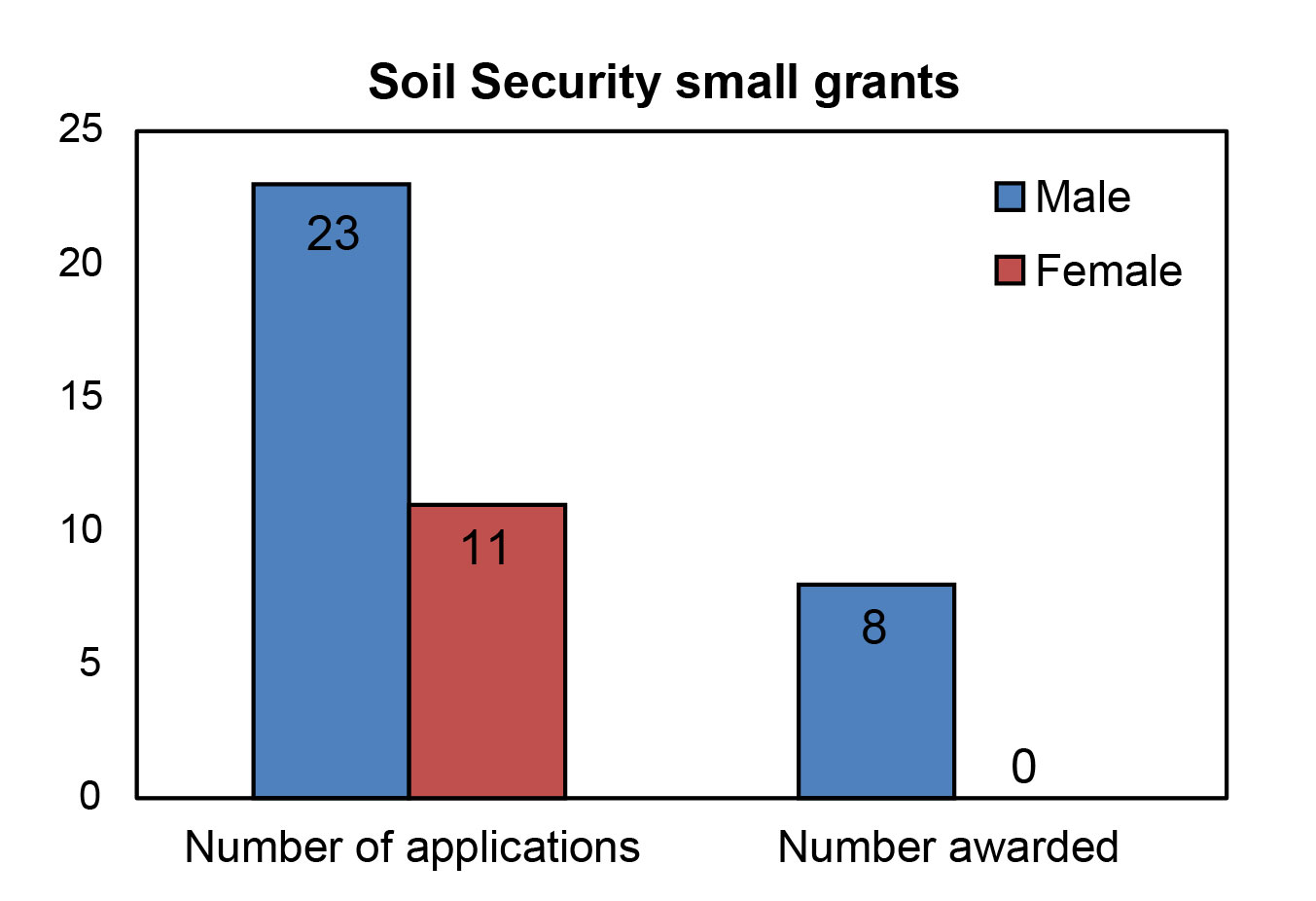
So what is causing this disparity? Why did we end up with ALL 15 projects funded within a large soil science programme, intended to bring the UK soil science community together, being led by men (obviously there are women involved in these projects, but they are not leading them)? Why do all the postdocs, PhD students, and co-investigators in this programme have to listen to a male dominated list of speakers at every programme meeting? Why is this the message we are giving, not only to the next generation of soil scientists, but to the entire soil science community in the UK, and abroad?
Because the message we are giving is that men lead – are in control of – the UK soil science community.
Were these 11 proposals written by women really of lower quality than all eight grants that were funded? Or was there unconscious bias somewhere along the way? It is impossible to tell, but personally, I refuse to believe that women are not capable of writing good proposals. And while the panel assessing the proposals was made up of 30% women, we know that women also have unconscious bias against women.
To really find out whether the field of soil science is more male-dominated than my other main field of research, ecology, I have compared gender statistics for society membership, conference keynote speakers, and editorial boards between soil science and ecology.
While 30% women in the UK soil science community doesn’t sound too terrible, it is still far behind the UK ecological community – 45% of the members of the British Ecological Society is female.
Second, soil science conferences are still dominated by male keynote speakers. The BSSS Annual Meetings vary strongly in the gender balance of their keynote speakers: from 50% in 2014, to 0% in 2015, and 33% in 2016. Similarly, the Wageningen Soil Conferences vary, but show an encouraging upwards trend: from 20% in 2011, to 33% in 2015, to 40% in 2017 (although here there are still a few outstanding slots as I am writing this). However, the Global Soil Biodiversity Conferences disappoint: they had 22% of female keynote speakers in 2014, but only 18% for the coming meeting in October 2017. In contrast, at the three most recent Annual Meetings of the British Ecological Society (2014, 2015, and 2016), at least 50% of the keynote speakers were female, and thisnumber varies between 22% and 100% at the three last meetings (2014, 2015, and 2016) of the Ecological Society of America.
When I looked at editorial boards, I found that for the soil journals, Soil Biology & Biochemistry has the healthiest gender balance, with 34% women on their editorial board. But European Journal of Soil Science, Soil Use and Management, and SOIL only reach 21%, 11%, and 20% of women, respectively. In contrast, the journals of the British Ecological Society are setting an example, with 45% and 44% women on the editorial boards of Journal of Ecology (note that for Journal of Ecology, I asked the managing editor for the numbers because the numbers on the website are out of date) and Functional Ecology. Other ecological journals are doing worse, with 25% and 23% for Ecology and OIKOS, respectively.
So it seems that yes, soil science is more male-dominated than ecology. And to drive the field forward and to motivate young women and other minorities to enter and stay in the fascinating world of soil science, something needs to change. Because young women do not want to go to conferences where all the speakers are men. Because there are too few women invited to referee for scientific journals, because male editors invite male reviewers, and because those might have a stronger unconscious bias against manuscripts authored by women than women do. Because a field where the more senior or privileged positions are filled by men, whether editorial boards, conference organisers, grant panels, or leadership committees of programmes such as Soil Security/SARISA, will self-perpetuate and be more likely to include men. Because women might give up when proposal after proposal is unsuccessful in getting funding. Because it is simply off putting to see that most senior positions in a field are held by men.
So what can we do to keep young, female soil scientists motivated and engaged, and to prevent losing them before they get their first permanent position?
It’s simple, really.
We should speak out whenever we see a gender imbalance. We should not stop talking, we should ask for the numbers, and we should make them public. We should not be deterred when we are not taken seriously. We should unite, and create a powerful voice that challenges inequalities. There are several options to unite in a network, for example 500 Women Scientists, who are creating a European group (contact me if you would like to be added to the email list or be involved).
We can also help ourselves by finding mentors and sponsors (they are not the same, and they don’t have to be women!), and by mentoring others. While there are many formal mentoring schemes for women, they are often oversubscribed, and mentoring does not have to be formal. You can find some useful resources here and here.
We should ask our organisations which measures they have in place to stimulate career progression for women, and demand that they apply for an Athena Swan award.
We should also, whenever we plan to apply for a grant, take enough time to have it read, and read again, and read again, by scientists both within and outside our discipline.
Funders should have a clear policy of how they minimise unconscious bias. They should acknowledge the causes of unconscious bias, and suggest possible solutions to reduce it.
For example, when grants are ranked at the end of a committee meeting, the panel should closely look at the gender balance and ask themselves where there might have been unconscious bias, and be open to re-evaluating the ranking. Because it is at the cut off between getting funded and not getting funded where unconscious bias has the biggest impact. They should also make sure that there are enough women on their panels to be representative of the field, and they should make panel members aware of unconscious bias and ways to reduce it. There is a scheme being rolled out by RCUK, and I know from my own experience that the BBSRC takes this very seriously (see also their report on gender bias in BBSRC funding).
They should also engage with and actively train the next generation of (soil) scientists. Programmes such as the Soil Security Programme should organise grant writing workshops and leadership workshops targeted at early career scientists, postdocs, and PhD students.
Journals should increase the number of women on their editorial boards, and encourage existing board members to find a diverse selection of referees for the manuscripts they are handling– not just women, but also reviewers from other minorities and non-first world countries.
Conference organisers should aim for 50% of female keynote speakers. There is no excuse anymore for a measly 10 or 20%, or even 0%. The internet has made it extremely easy to find female scientists in any field, and to make it even easier, several discipline-specific lists exist, such as the list of women in microbiome research on Microbiome Digest. There isn’t one for female soil scientists yet, which is why I am working on starting one. Please contact me if you would like to be added, or wait until the form appears here on my blog.


 Frantecologist
Leave a reply to franciskadevries Cancel reply